
Unlock the White House Watch newsletter for free
Your guide to what Trump’s second term means for Washington, business and the world
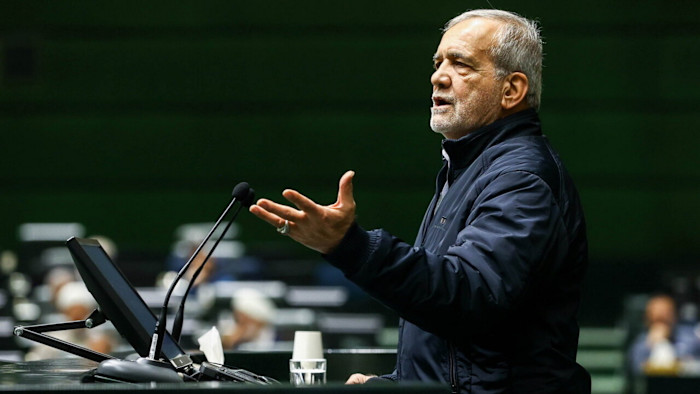
Iran’s President Masoud Pezeshkian said Tehran was engaged in an unprecedented “all-out war” with the US, Europe and Israel as US President Donald Trump prepared to meet Israel’s prime minister in Washington.
Pezeshkian warned that Iran’s military forces were “more prepared” than ever and would respond to any new aggression, as Trump and Israeli Prime Minister Benjamin Netanyahu were expected to discuss Iran in their meeting on Monday.
“We are in an all-out war with the US, Israel and Europe,” Pezeshkian said.
“They do not want our country to stand upright . . . and are surrounding us from all sides: economically, culturally, politically and from a security perspective,” he told Khamenei.ir, the supreme leader’s news website, in an interview published on Saturday.
“While they raise society’s expectations, they block our [oil] sales and our trade, undermining people’s livelihoods.”
Many Iranians fear that Netanyahu could receive a green light from Trump to attack Iran again, while fears of further conflict have weighed on the economy and the national psyche after the US joined Israel in its 12-day war in June against Iran and bombed key nuclear sites.
Pezeshkian said Iran’s arch-foes had capitalised on public discontent in the Islamic republic, maintaining that their plan during the war was to bring about regime change — an effort he said had been replaced by a new plot to achieve the same goal “within 36 months”.
He gave no further details but warned that the country’s military forces were working hard to strengthen their capabilities and foil the threats.
“Our military forces are stronger than they were when we were attacked, and they are moving forward decisively in terms of equipment and manpower, despite all the problems we face,” he said.
“If we maintain unity at home, they will be disappointed and rethink any attack on our country. They are counting on domestic developments to intervene.”
He urged political factions to keep their infighting behind closed doors and present a united front, adding that Ayatollah Ali Khamenei, in his weekly meetings with the president, focused exclusively on people’s livelihoods.
Economic hardship has deepened since the June war. Iranians are increasingly anxious about soaring inflation and the sharp fall of the national currency, which has hit new lows against the dollar in recent weeks.
The economy contracted from late March 2025 to late September, according to the latest official figures, while annual food inflation hit 72.3 per cent between November 22 and December 21.
Pezeshkian acknowledged his government was struggling with declining revenues, saying in the interview that a drop in global oil prices had also dealt a heavy blow to Iran’s income.
That added to what he described as “extensive” problems in “water, financial management, politics, social affairs, the economy and culture”.
“Under the pressure [of sanctions], our revenues have declined on the one hand. On the other hand, there was a war, and some of our services and production have been disrupted,” he said.
Talks with the US towards an agreement on Iran’s nuclear programme and a potential lifting of some western sanctions were abruptly suspended during the June war. Deep disagreements between the sides remain, with Tehran maintaining it will not accept a reduction of its uranium enrichment to zero, as requested by the US.
Read the full article here